
Finding Function Range: Expert Tips Explained
Finding Function Range: Expert Tips Explained
Understanding how to find the range of a function is one of the most essential skills in mathematics, whether you’re tackling algebra, calculus, or advanced problem-solving. The range represents all possible output values that a function can produce, and mastering this concept opens doors to deeper mathematical understanding. Many students struggle with range because it requires both analytical thinking and visual interpretation of how functions behave across different domains.
In this comprehensive guide, we’ll walk you through multiple methods for determining function ranges, from simple linear functions to complex rational and trigonometric expressions. Whether you’re preparing for an exam, helping your student with homework, or simply brushing up on mathematical fundamentals, these expert tips will give you the confidence to tackle any range problem with clarity and precision.
Understanding Functions and Their Ranges
Before diving into methods for finding ranges, it’s crucial to establish what we mean by a function and its range. A function is a mathematical relationship where each input (x-value) corresponds to exactly one output (y-value). The domain is the set of all possible input values, while the range is the set of all possible output values the function can actually produce.
Think of a function like a machine: you feed it an input (domain), and it produces an output (range). Not every possible output value might be achievable—that’s what makes finding the range interesting. For instance, if you have a function that squares numbers, the range will only include non-negative values because you can’t get negative outputs from squaring real numbers.
The range is typically expressed in several ways: interval notation (like [2, ∞)), set-builder notation (like {y | y ≥ 2}), or inequality notation (y ≥ 2). Understanding which notation your instructor prefers is important for clear communication of your answers.

Method 1: Graphical Analysis
The graphical method is often the most intuitive way to find a function’s range, especially for visual learners. By plotting the function on a coordinate system, you can literally see which y-values the function touches or covers.
Steps for graphical analysis:
- Plot several points by substituting x-values into the function
- Connect these points to visualize the function’s shape
- Identify the lowest and highest y-values the graph reaches
- Look for any gaps or discontinuities in the y-values
- Determine whether endpoints are included (closed circles) or excluded (open circles)
For a parabola like f(x) = x² + 2, when you graph it, you’ll see the curve has a minimum point at (0, 2) and extends upward infinitely. This means the range is [2, ∞). The square bracket indicates that 2 is included in the range.
When using graphical analysis, pay special attention to asymptotes—these are lines that the function approaches but never actually touches. If you need to understand asymptotes better, our guide on how to find the horizontal asymptote provides detailed explanations. A function might approach a horizontal asymptote but never reach it, which affects the range.
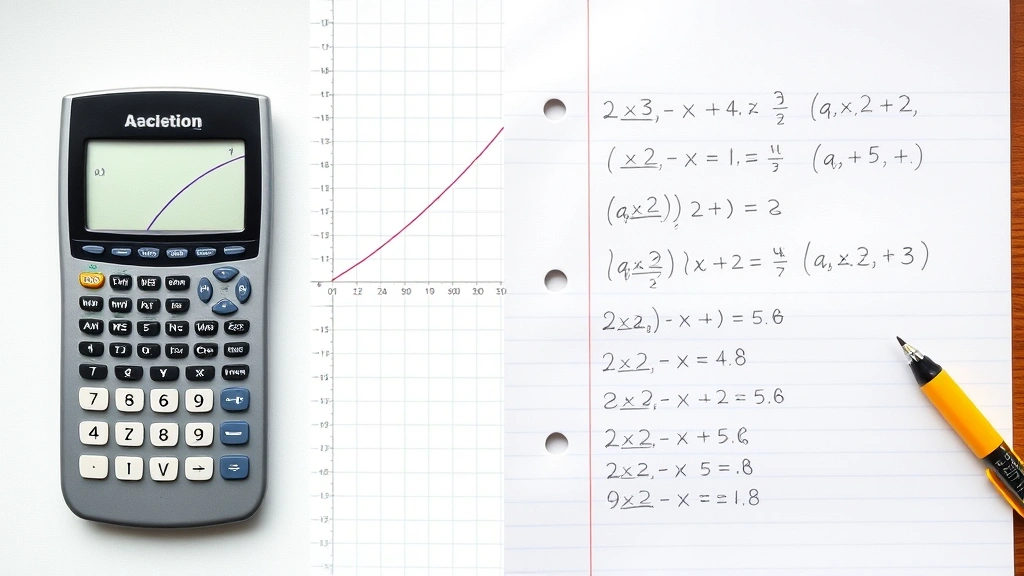
Modern graphing calculators and software like Desmos make this method incredibly accessible. You can input your function and instantly see its behavior across different x-values, making it easier to identify the range at a glance.
Method 2: Algebraic Manipulation
The algebraic method involves solving for x in terms of y and analyzing what values of y are actually achievable. This technique works particularly well for rational functions and polynomial expressions.
The algebraic approach:
- Start with y = f(x)
- Rearrange the equation to solve for x in terms of y
- Determine which y-values make x defined and real
- Apply any restrictions from the original function
Let’s work through an example. For the function f(x) = (2x + 1)/(x – 3), we set y = (2x + 1)/(x – 3) and solve for x:
y(x – 3) = 2x + 1
yx – 3y = 2x + 1
yx – 2x = 3y + 1
x(y – 2) = 3y + 1
x = (3y + 1)/(y – 2)
Now, for x to be defined, the denominator cannot equal zero, so y ≠ 2. This means the range is all real numbers except 2, written as (-∞, 2) ∪ (2, ∞).
This algebraic method reveals why certain y-values are excluded from the range. It’s particularly powerful for rational functions where you can identify which values cause undefined expressions.
Method 3: Using Calculus and Critical Points
For more complex functions, especially those involving polynomials of degree three or higher, calculus provides powerful tools for finding exact range values. This method involves finding critical points where the function reaches local maximums or minimums.
Calculus-based approach:
- Find the derivative f'(x)
- Set f'(x) = 0 and solve for critical points
- Evaluate the function at critical points and endpoints
- Compare values to identify global maximum and minimum
- Express the range based on these extreme values
Consider f(x) = x³ – 3x² on the interval [0, 4]. Taking the derivative: f'(x) = 3x² – 6x = 3x(x – 2). Critical points are x = 0 and x = 2.
Evaluating at critical points and endpoints:
f(0) = 0
f(2) = 8 – 12 = -4
f(4) = 64 – 48 = 16
The minimum value is -4 and the maximum is 16, so the range is [-4, 16]. This method ensures you don’t miss any important features of the function.
Special Function Types and Their Ranges
Different function types have characteristic range behaviors. Understanding these patterns helps you quickly determine ranges without extensive calculations.
Linear Functions: Functions like f(x) = 2x + 3 have a range of all real numbers (-∞, ∞) unless the domain is restricted. The continuous, non-horizontal line means every y-value is achievable.
Quadratic Functions: Parabolas like f(x) = ax² + bx + c have ranges that depend on whether they open upward or downward. The vertex represents either a minimum or maximum value. For upward-opening parabolas, the range is [vertex y-value, ∞).
Exponential Functions: Functions like f(x) = 2^x have ranges of (0, ∞). They never produce zero or negative outputs, no matter what x-value you use. The function approaches zero as x approaches negative infinity but never reaches it.
Logarithmic Functions: The function f(x) = log(x) has a range of all real numbers (-∞, ∞). Logarithms can produce any real output value depending on the input.
Trigonometric Functions: The sine and cosine functions have ranges of [-1, 1]. These functions oscillate between these exact bounds regardless of input values.
Absolute Value Functions: Functions like f(x) = |x| have ranges of [0, ∞). The absolute value can never produce negative numbers.
Understanding these patterns accelerates your ability to identify ranges, especially when you encounter composite functions that combine these basic types.
Common Mistakes to Avoid
Even experienced mathematicians can make errors when finding ranges. Being aware of common pitfalls helps you maintain accuracy and confidence in your answers.
Mistake 1: Confusing Domain and Range The domain is input; the range is output. Don’t accidentally determine which x-values are possible instead of which y-values are possible. Keep clear mental separation between these two concepts.
Mistake 2: Forgetting About Discontinuities Some functions have gaps or breaks. A function might seem like it should produce a certain y-value, but if there’s a hole or vertical asymptote at that point, that value is excluded from the range. Always check for discontinuities.
Mistake 3: Assuming All Functions Are Continuous Piecewise functions, rational functions with restrictions, and functions with jump discontinuities require careful analysis. Don’t assume smooth, continuous behavior without verification.
Mistake 4: Neglecting Boundary Behavior Always examine what happens at the edges of the domain. Does the function approach a limit? Does it reach a maximum or minimum? These boundary behaviors often determine the range.
Mistake 5: Forgetting Negative Values in Even-Degree Polynomials While f(x) = x² produces only non-negative outputs, f(x) = -(x²) produces only non-positive outputs. Pay attention to coefficients and transformations.
If you’re working with functions involving triangles or geometric relationships, understanding how to find the missing side of a triangle or find the hypotenuse of a triangle might provide additional constraints for your range calculations. These geometric relationships often define domain and range restrictions.
FAQ
What’s the difference between range and domain?
The domain consists of all possible input values (x-values) that you can feed into a function. The range consists of all possible output values (y-values) that the function actually produces. For f(x) = √x, the domain is [0, ∞) because you can’t take square roots of negative numbers, and the range is also [0, ∞) because square roots produce non-negative outputs.
How do I find the range of a function without graphing?
Use algebraic manipulation by setting y = f(x) and solving for x in terms of y. Determine which y-values make x defined and real. Alternatively, use calculus to find critical points and evaluate the function at those points to identify maximum and minimum values. For special function types, memorize their characteristic ranges.
Can a function’s range be a single value?
Yes, absolutely. A constant function like f(x) = 5 has a range of {5}—only one value. Any function that maps all inputs to the same output has a range consisting of a single element.
What does it mean if the range is all real numbers?
If the range is (-∞, ∞) or ℝ, it means the function can produce any real number as an output. Linear functions with non-zero slope, cubic functions, and logarithmic functions typically have this property. The function is surjective onto the real numbers.
How do asymptotes affect the range?
Asymptotes are lines that a function approaches but never reaches. A horizontal asymptote at y = c means the function gets arbitrarily close to c but never equals c, so c is excluded from the range. This is why rational functions often have restricted ranges—horizontal asymptotes exclude certain y-values.
Is there a quick way to find the range of composite functions?
For composite functions like f(g(x)), find the range of the inner function g(x) first, then treat those output values as inputs for f. The range of f applied to g’s range gives you the final range. This method breaks complex problems into manageable pieces.
How do I express my answer for the range?
Use interval notation [a, b] for closed intervals, (a, b) for open intervals, or combinations like [a, b) for half-open intervals. You can also use set-builder notation {y | conditions} or inequality notation like y ≥ a. Check your course materials for the preferred format. For additional context on statistical ranges and spread, explore our guide on how to find Q1 and Q3 or how to find mean absolute deviation.

Related Posts

Superscript in Google Docs: Expert Tips

Strikethrough in Excel: Easy Steps for Beginners
