
How to Tune a Guitar: Expert Guide
How to Tune a Guitar: Expert Guide for Perfect Sound Every Time
There’s something deeply satisfying about the moment your guitar snaps into perfect pitch. That sweet resonance when all six strings align in harmony isn’t just pleasant to the ear—it’s the foundation of everything that comes after. Whether you’re about to record your first demo, jam with friends, or simply practice your favorite riffs, a properly tuned guitar is non-negotiable.
The challenge? Tuning a guitar shouldn’t feel like solving a physics equation. Too many beginners get frustrated because they’re either using the wrong method for their skill level or they don’t understand what they’re actually listening for. The good news is that modern guitarists have more options than ever, and we’re going to walk through each one so you can find your perfect match.
Let’s cut through the confusion and get your instrument sounding like it should. By the end of this guide, you’ll understand not just how to tune a guitar, but why each method works and when to use it.
Why Tuning Your Guitar Matters
Before we dive into the mechanics, let’s address the elephant in the room: why does tuning actually matter? Beyond the obvious answer that it sounds better, tuning affects your entire playing experience.
When your guitar is out of tune, your muscle memory gets confused. You practice a chord progression a hundred times with strings slightly sharp or flat, and suddenly your brain learns incorrect finger positions. This creates a frustrating cycle where improvement plateaus because you’re reinforcing wrong technique.
Additionally, an out-of-tune guitar can damage your instrument over time. Strings under inconsistent tension wear unevenly, and the neck experiences stress from improper load distribution. Think of it like driving a car with misaligned wheels—sure, it still moves, but you’re creating unnecessary wear.
Finally, there’s the psychological element. Playing an in-tune guitar is genuinely motivating. Those pure, ringing tones encourage you to practice longer and engage more deeply with your music. It’s the difference between playing guitar and actually enjoying playing guitar.

Understanding Standard Tuning
Standard tuning is the reference point for 99% of guitar playing. From lowest to highest string, it goes: E, A, D, G, B, E. This sequence has been standardized for over a century because it provides excellent range, accessibility for common chord shapes, and balanced string tension.
Here’s a helpful way to remember it: Eddie Ate Dynamite, Good Bye Eddie. That mnemonic has stuck with countless guitarists since the 1970s, and for good reason—it works.
Each string vibrates at a specific frequency measured in Hertz (Hz). The low E string vibrates at 82.4 Hz, while the high E string vibrates at 329.6 Hz. Digital tuners measure these frequencies and show you whether each string is sharp (too high), flat (too low), or perfectly in tune. Understanding this concept helps you make sense of what your tuner is telling you.
It’s worth noting that while standard tuning dominates, alternative tunings exist for specific musical styles. Drop D tuning, open G, and countless others serve particular purposes. However, mastering standard tuning first gives you the foundation to experiment confidently.
Five Proven Tuning Methods
The method you choose depends on your situation, equipment, and skill level. Let’s explore each option with honest assessments of their strengths and limitations.
Method 1: Digital Clip-On Tuner
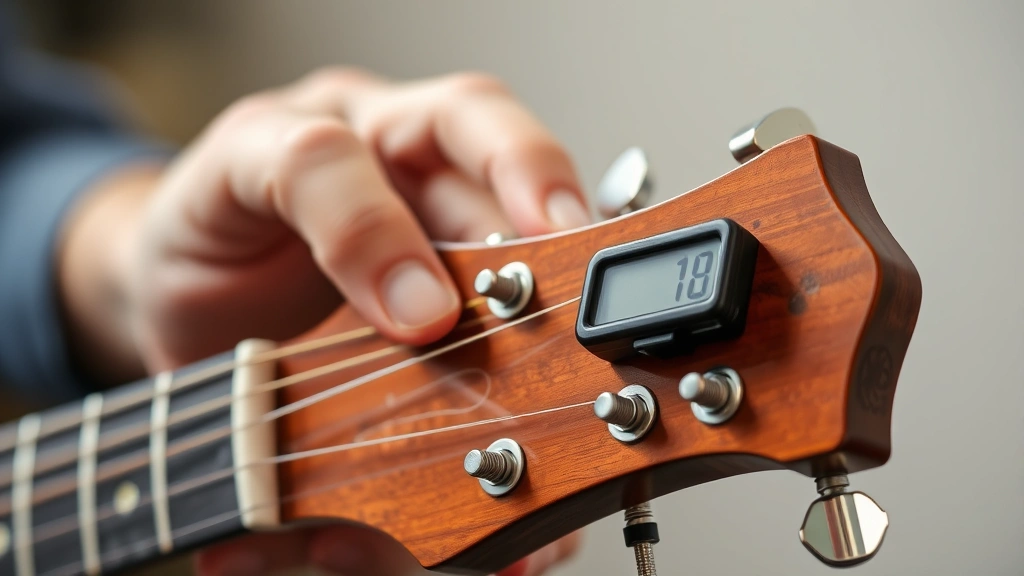
This is the modern standard for good reason. A clip-on tuner attaches to your guitar’s headstock and measures string vibrations directly. The process is straightforward: pluck each string, watch the display show whether you’re sharp or flat, and adjust the tuning peg until the needle centers or the display shows green.
The beauty of clip-on tuners is their accuracy and speed. Even budget models costing $15-25 are reliable enough for serious practice. They work in noisy environments where your ear would struggle, and they’re portable enough to take anywhere.
The slight downside? They can occasionally miss vibrations if your technique is weak, and they require batteries. Still, this is the method we’d recommend for 90% of guitarists.
Method 2: Smartphone Tuner Apps
If you always have your phone nearby (and who doesn’t?), tuner apps offer convenience without additional expense. Popular options include GuitarTuna, Pano Tuner, and Tune-It, all available on iOS and Android.
These apps use your phone’s microphone to detect string frequencies. They’re surprisingly accurate and often include additional features like metronomes and chord libraries. The primary limitation is that phone microphones can be inconsistent, and ambient noise causes issues more easily than with dedicated tuners.
Our honest take: smartphone apps work great as backups or for casual practice at home, but serious musicians benefit from a dedicated clip-on tuner’s reliability.
Method 3: Relative Tuning by Ear
This method requires no equipment beyond your guitar and a well-trained ear. You tune the first string (usually low E) to a reference note, then use that as your anchor to tune all remaining strings relative to it.
The process involves fretting the low E string at the fifth fret (which produces an A note) and matching the open A string to that pitch. Then you fret the A string at the fifth fret and match the open D string, and so on. This technique builds your ear training simultaneously—a genuine skill that transfers to your overall musicianship.
The catch? You need an initial reference. Many guitarists use a piano, tuning fork, or even YouTube videos that play reference pitches. Without that starting point, relative tuning becomes guesswork.
Method 4: Tuning Fork Method
Tuning forks represent the old-school approach, and they’re still legitimate. Strike the fork against your knee (gently), hold it near your ear, and listen to the pure reference tone. Then pluck your string and adjust until it matches that pitch.
This method is beautifully simple and requires no batteries or technology. It’s also excellent for ear training. However, it demands significant listening skill and patience. Each string requires individual attention, and environmental noise complicates matters.
Method 5: Piano or Keyboard Reference
If you have access to a piano or keyboard, you can tune by matching each string to its corresponding key. This method is highly accurate and helps you understand the relationship between guitar strings and piano keys—knowledge that enhances your overall musical comprehension.
The limitation is obvious: you need access to a quality instrument. For studio musicians or those with a home keyboard, this works beautifully. For practice on the go, it’s impractical.

Using Digital Tuners: A Step-by-Step Walkthrough
Since digital tuners are the most practical option for most players, let’s break down the exact process to ensure you’re doing it correctly.
- Clip the tuner to your headstock. Position it so the display faces you and the tuner can feel string vibrations. Some tuners work better slightly offset to the side rather than perfectly centered.
- Select your tuning mode. Most tuners default to standard tuning, but check that it’s set correctly. Some advanced tuners offer alternative tuning modes.
- Pluck the low E string firmly. Use a clear, deliberate pluck—not a gentle tap. The tuner needs enough vibration to register accurately.
- Watch the display. You’ll see an indicator showing whether the string is sharp (right), flat (left), or in tune (center). Some tuners use a needle, others use LED lights or digital displays.
- Turn the tuning peg slowly. If the string is flat, turn the tuning peg toward you (generally). If it’s sharp, turn away. Move gradually—overshooting is frustrating.
- Center the needle or indicator. Stop adjusting when the display shows the string is perfectly in tune. You’ll know it when you see it.
- Repeat for all six strings. Work from lowest to highest string, and don’t be surprised if the low E string goes slightly flat as you tune the others. This is normal—go back and retune it after completing all strings.
Pro tip: After tuning all six strings, go back through them one more time quickly. Newly tightened strings often settle slightly out of tune, and this quick pass catches those adjustments.
Training Your Ear: Building Musical Instinct
Here’s something most tuning guides skip: developing your ear is genuinely important for long-term musical growth. Even if you use a digital tuner for practical purposes, ear training makes you a better musician.
Start by listening carefully to what in-tune and out-of-tune sounds like. Intentionally detune a string and listen to the subtle wavering sound (called beats) that occurs when frequencies are slightly misaligned. Then tune it perfectly and hear the difference. This auditory memory becomes your internal reference.
Practice relative tuning weekly, even for just five minutes. Tune your first string with a tuner, then use relative tuning for the remaining strings. Over months, you’ll develop surprising accuracy without any device.
If you’re serious about musicianship, consider exploring our guide on how to read guitar tabs alongside ear training. Understanding musical notation and tab helps you internalize pitch relationships more effectively.
Interestingly, musicians who develop strong ear skills often cross-pollinate their abilities into other areas. If you’re interested in rhythm instruments, learning how to play spoons teaches similar listening and coordination skills. Even seemingly unrelated pursuits like how to sharpen a knife involve developing tactile sensitivity that complements musical training.
The broader point: musicianship isn’t compartmentalized. Every skill you develop in one area supports growth in others.
Maintenance Tips for Consistent Tuning
Getting your guitar in tune is one thing. Keeping it in tune is another. Several factors affect tuning stability, and understanding them helps you maintain consistency.
New strings need extra attention. Fresh strings take time to settle. During the first few hours of playing, they’ll go flat repeatedly as the metal fibers adjust to tension. This isn’t a defect—it’s normal. Retune frequently during the first day with new strings.
Temperature matters more than most players realize. Wood expands and contracts with humidity and temperature changes. A guitar left in a cold car or near a heating vent will go noticeably out of tune. Keep your instrument in a stable environment when possible, and allow time for it to adjust after moving between temperature extremes.
Humidity affects wood stability. Ideal humidity sits around 45-55%. Too dry, and the wood shrinks slightly, affecting tension and tuning stability. Too humid, and the opposite occurs. A guitar humidifier in dry climates or a dehumidifier in wet ones prevents these issues.
Check your bridge and nut regularly. If your bridge is lifting or your nut is cracked, tuning stability suffers dramatically. These components need professional attention if they’re compromised.
Ensure tuning pegs are tight. Loose tuning pegs slip under string tension, causing unexpected pitch drops. If your tuning pegs feel loose, a simple tightening (not over-tightening) often solves the problem.
Common Tuning Problems Solved
Problem: One string keeps going flat no matter how many times you tune it.
This usually indicates a tuning peg that’s slipping or a string that’s damaged. Try replacing the string first—if the problem persists, the tuning peg needs attention from a luthier or experienced technician.
Problem: Your tuner shows green (in tune) but the guitar sounds out of tune.
Your tuner is accurate, but your ears might be detecting intonation issues beyond basic tuning. This often happens when the bridge or nut is misaligned. Alternatively, your guitar might need a professional intonation setup where the bridge saddle is adjusted for proper pitch across all frets.
Problem: Tuning takes forever because the strings won’t stabilize.
New strings or recent string replacement causes this. Give the strings time to settle (typically 24 hours of playing), and retune more frequently during this period. Gently stretching new strings by pulling on them slightly at various points along their length can speed up settling.
Problem: The tuner registers different pitches when you pluck gently versus hard.
This suggests intonation issues or possibly a damaged tuning mechanism. A professional setup can diagnose whether it’s a simple problem or something requiring more involved repair. For reference, authoritative resources like This Old House often feature guitar maintenance advice from qualified professionals.
Problem: Your open strings sound in tune, but chords sound off.
This is almost certainly an intonation problem rather than a tuning problem. Even if open strings are perfect, if the frets aren’t properly positioned or the bridge saddle isn’t correctly angled, fretted notes will sound out of tune. This requires professional setup or adjustment.
Frequently Asked Questions
How often should I tune my guitar?
For casual players, once daily before practice is standard. For serious musicians or performers, tuning before each session plus a quick check before playing is wise. New strings require more frequent tuning during their first day.
Can I tune my guitar too much?
No, tuning your guitar doesn’t damage it. However, over-tightening strings beyond their rated pitch can break them. Stick to standard tuning specifications and you’re fine.
Why does my guitar go out of tune so quickly?
New strings, temperature changes, loose tuning pegs, or a worn bridge nut are the usual culprits. Address each systematically: first check your tuning pegs for tightness, then consider your environment’s temperature and humidity stability. If the problem persists, professional inspection becomes necessary.
Is one tuning method better than others?
For practical purposes, digital clip-on tuners offer the best balance of accuracy, speed, and reliability. However, developing ear training through relative tuning or tuning fork methods enhances your musicianship. Ideally, use a digital tuner for consistency while practicing ear training separately.
Do expensive tuners work better than cheap ones?
Budget tuners ($15-30) are accurate enough for serious practice and performance. Premium tuners ($50+) offer additional features, faster response times, and sometimes better visibility in bright light. The difference is noticeable but not revolutionary. A $25 clip-on tuner is perfectly adequate for most guitarists.
Can I use a tuner designed for other instruments on my guitar?
Generally yes, but guitar-specific tuners often include features that make the process easier, like visual indicators optimized for string vibration patterns. Universal tuners work, but you might find guitar-specific models more user-friendly.
What’s the difference between sharp and flat?
Sharp means the pitch is too high (the string is tensioned too tightly). Flat means the pitch is too low (the string isn’t tensioned enough). Your tuner will clearly indicate which direction to adjust.
Should I learn to tune by ear before using a digital tuner?
There’s no wrong order, but most modern players use digital tuners first, then develop ear training gradually. Learning relative tuning by ear after you’re comfortable with digital tuning accelerates your musical development without creating initial frustration.

Related Posts

How Long to Boil Lobster Tails: Cooking Guide

How Long to Fly from New York to London? Travel Times
