

Calculate Real GDP? Expert Techniques Unveiled
How to Calculate Real GDP: Expert Techniques Unveiled
Understanding how to calculate real GDP is essential for anyone interested in economics, finance, or making informed decisions about the broader economy. Real Gross Domestic Product represents the total monetary value of all finished goods and services produced within a country’s borders, adjusted for inflation to reflect true economic growth. Unlike nominal GDP, which can be misleading due to price fluctuations, real GDP gives you an accurate picture of whether an economy is actually expanding or contracting.
Whether you’re a student, investor, or simply curious about economic indicators, mastering real GDP calculations will enhance your financial literacy and decision-making abilities. This comprehensive guide breaks down the process into manageable steps, providing you with the tools and knowledge needed to calculate real GDP like a professional economist.
Understanding the Basics of Real GDP
Real GDP serves as a crucial economic indicator that measures a nation’s economic performance without the distortion of inflation. When you calculate real GDP, you’re essentially removing the effects of price changes to see the true volume of goods and services produced. This adjustment is critical because inflation can mask whether an economy is genuinely growing or simply experiencing higher prices.
The fundamental concept behind real GDP is straightforward: it answers the question, “How much economic value was actually created?” rather than “What was the dollar value assigned to that creation?” This distinction becomes particularly important when comparing economic performance across different years or when analyzing long-term trends. For instance, if nominal GDP increased by 5% but inflation was 4%, the real growth was only 1%—a significant difference for policymakers and investors.
To properly understand real GDP, you need to grasp several foundational elements. First, recognize that all goods and services produced domestically count toward GDP, regardless of who produces them. Second, understand that the calculation requires a base year—a reference point against which all other years are measured. Finally, appreciate that real GDP adjustments transform nominal values into comparable, inflation-adjusted figures that reveal true economic expansion or contraction.
Nominal GDP vs. Real GDP: Key Differences
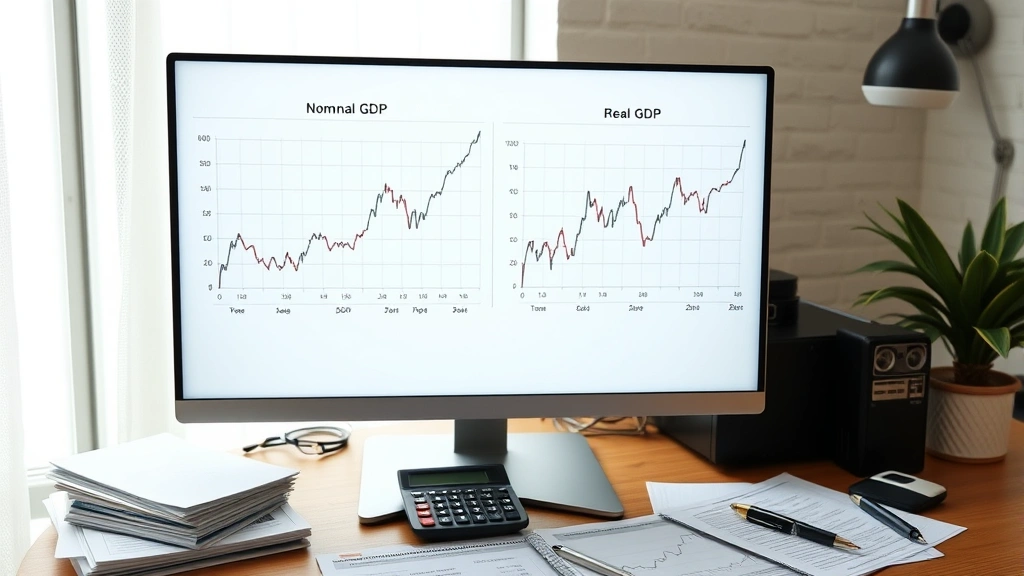
The distinction between nominal and real GDP is fundamental to economic analysis. Nominal GDP represents the raw, unadjusted value of all goods and services produced in a given year, calculated using current prices. Real GDP, conversely, adjusts these values to a base year’s price level, eliminating inflation’s distorting effects. Understanding this difference is essential before you attempt to calculate real GDP.
Consider a practical example: suppose a country produced 100 widgets in Year 1 at $10 each (nominal GDP = $1,000) and 110 widgets in Year 2 at $11 each (nominal GDP = $1,210). The nominal increase appears to be 21%, but if inflation was 10%, the real increase in production was only 10%. This demonstrates why nominal GDP alone can be misleading when assessing true economic growth.
Real GDP provides economists, policymakers, and investors with a more accurate representation of economic health. When you examine historical GDP data from government sources like the Bureau of Economic Analysis, you’ll notice both figures are reported. The nominal figure shows the raw economic output, while the real figure reveals whether the economy actually expanded in terms of productive capacity and output volume.
The relationship between nominal and real GDP can be expressed mathematically: Real GDP = (Nominal GDP / GDP Deflator) × 100. This formula is central to most real GDP calculations and demonstrates the direct relationship between these two measures. When inflation rises, the deflator increases, which decreases real GDP relative to nominal GDP.
The GDP Deflator Method
The GDP deflator is the primary tool economists use to convert nominal GDP into real GDP. This price index measures the average change in prices paid by domestic producers for goods and services. Unlike the Consumer Price Index (CPI), which focuses on consumer purchases, the GDP deflator encompasses all domestically produced goods and services, making it more comprehensive for GDP calculations.
To calculate real GDP using the deflator method, you’ll need two essential pieces of information: the nominal GDP for the year you’re analyzing and the GDP deflator for that same year. The GDP deflator is typically expressed as an index number where the base year equals 100. For example, if the current year’s deflator is 120 and the base year is 100, prices have increased by 20% since the base year.
The mathematical formula for this method is elegantly simple: Real GDP = (Nominal GDP / GDP Deflator) × 100. If a country’s nominal GDP in 2023 was $25 trillion and the GDP deflator was 125, the real GDP would be ($25 trillion / 125) × 100 = $20 trillion in base year dollars. This calculation reveals that while the nominal economy grew to $25 trillion, the actual production volume corresponded to $20 trillion in base year values.
Understanding how to calculate real GDP using the deflator requires recognizing that this method implicitly assumes all prices throughout the economy change proportionally. In reality, different sectors experience different inflation rates, which is why some economists prefer alternative methods. However, the deflator method remains the most widely used and officially recognized approach by government statistical agencies worldwide.
Base Year Selection and Its Importance
Selecting an appropriate base year is a critical decision that affects how real GDP calculations are interpreted and compared. The base year serves as the reference point—the year assigned a value of 100 on the GDP deflator index. All other years are then measured relative to this baseline, making the base year selection profoundly important for accurate economic analysis.
Government statistical agencies periodically update their base year, typically every 5-10 years. The United States, for instance, has used various base years including 1992, 2000, 2009, and currently 2012. When base years change, historical real GDP figures are recalculated to maintain consistency. This practice ensures that comparisons between recent years and historical data remain meaningful and accurate.
The choice of base year affects the magnitude of real GDP figures but not the growth rates between years. For example, if you calculate real GDP using 2012 as the base year versus 2020 as the base year, the absolute dollar amounts will differ, but the percentage growth from 2021 to 2022 will remain identical. This characteristic makes base year selection primarily a matter of convenience and consistency rather than analytical accuracy.
When conducting your own real GDP calculations or analyzing economic data, always note which base year is being used. This information is crucial for proper interpretation and comparison. Most official statistics from organizations like the International Monetary Fund and national statistical agencies clearly indicate their base year, allowing you to make accurate comparisons across different datasets.
Step-by-Step Calculation Process
Now that you understand the foundational concepts, let’s walk through the practical process of how to calculate real GDP. This step-by-step approach will give you the confidence to perform these calculations independently and understand each component’s role in the final result.
Step 1: Gather Your Data
Begin by collecting the necessary information. You’ll need the nominal GDP for the year you’re analyzing and the corresponding GDP deflator value. These figures are typically available from government statistical agencies. In the United States, the Bureau of Economic Analysis publishes this data quarterly and annually. For international comparisons, the World Bank and IMF maintain comprehensive databases.
Step 2: Identify Your Base Year
Determine which base year your deflator index uses. Most modern data uses a consistent base year (like 2012 in the U.S.), but older datasets might use different references. Ensure consistency: if your deflator uses 2012 as the base year (deflator = 100 in 2012), your real GDP will be expressed in 2012 dollars.
Step 3: Locate the GDP Deflator
Find the GDP deflator value for your target year. This index is publicly available and typically published alongside nominal GDP figures. For example, if you’re calculating 2023 real GDP, you need the 2023 GDP deflator value. Government websites provide these figures in both historical tables and current economic reports.
Step 4: Apply the Formula
Use the fundamental formula: Real GDP = (Nominal GDP / GDP Deflator) × 100. Divide the nominal GDP by the deflator, then multiply by 100. For instance: Real GDP = ($27 trillion / 128) × 100 = $21.09 trillion in base year dollars.
Step 5: Interpret Your Results
Once calculated, your real GDP figure represents the value of all goods and services produced, expressed in base year prices. Compare this figure to previous years’ real GDP to determine genuine economic growth rates. If real GDP increased from $21 trillion to $21.5 trillion, the economy grew by approximately 2.4% in real terms.
Step 6: Calculate Growth Rates
To find the real GDP growth rate between two years, use this formula: Growth Rate = ((Real GDP Year 2 – Real GDP Year 1) / Real GDP Year 1) × 100. This percentage reveals the true economic expansion, unaffected by inflation distortions.

Using the Price Index Method
An alternative approach to calculating real GDP involves using specific price indices for different economic sectors. This method is more granular than the overall GDP deflator approach and can provide more accurate results when different sectors experience vastly different inflation rates. Understanding this method gives you additional tools for economic analysis.
The price index method requires breaking down the economy into its major components: consumer goods, investment goods, government services, and net exports. For each component, you calculate a separate price index, then apply it to convert that component’s nominal value into real value. Finally, you sum all the real components to arrive at total real GDP.
This approach aligns with how GDP is calculated using the expenditure method: GDP = C + I + G + (X – M), where C is consumption, I is investment, G is government spending, and (X – M) is net exports. By applying specific deflators to each component, you account for the reality that consumer prices might rise 3% while investment goods prices rise 1%.
For most practical purposes and when working with published data, the GDP deflator method suffices. However, if you’re conducting detailed economic research or need to understand sectoral differences in inflation, the price index method provides valuable insights. Government agencies often publish detailed breakdowns allowing you to calculate real GDP this way if needed.
Common Mistakes to Avoid
When learning how to calculate real GDP, several common pitfalls can lead to incorrect results or misinterpretation. Being aware of these mistakes will help you maintain accuracy and credibility in your economic analysis.
Mistake 1: Confusing the Deflator Direction
Remember that you divide nominal GDP by the deflator, not multiply. A higher deflator indicates more inflation, which means nominal GDP overstates real output. Dividing by the higher number correctly reduces nominal GDP to reflect true production levels.
Mistake 2: Ignoring Base Year Consistency
When comparing real GDP figures from different sources, verify they use the same base year. Comparing real GDP in 2005 dollars to real GDP in 2012 dollars without conversion will lead to erroneous conclusions. Always convert to a common base year before making comparisons.
Mistake 3: Forgetting to Multiply by 100
The formula includes multiplying by 100 because the deflator is expressed as an index (base year = 100). Omitting this step will produce real GDP values that are 100 times too small, a significant error that’s easy to overlook.
Mistake 4: Using Consumer Price Index Instead of GDP Deflator
While related, the CPI and GDP deflator are different measures. The CPI focuses on consumer prices, while the GDP deflator encompasses all domestically produced goods and services. Using CPI to calculate real GDP will produce inaccurate results, particularly for years with significant differences in investment or government spending inflation.
Mistake 5: Misinterpreting Growth Rates
Remember that real GDP growth rate is the percentage change in real GDP between periods, not the deflator value itself. A GDP deflator of 110 doesn’t mean the economy grew 10%; it means prices increased 10%. Calculate growth rates using the formula provided earlier to avoid this confusion.
Real-World Applications and Examples
Understanding how to calculate real GDP becomes most valuable when applying it to real economic situations. Let’s examine several practical scenarios demonstrating this technique’s importance in economic decision-making and analysis.
Example 1: Comparing Economic Performance Across Decades
Suppose you’re analyzing whether the U.S. economy performed better in 2000 or 2020. Nominal GDP was approximately $10.3 trillion in 2000 and $21 trillion in 2020, suggesting a doubling of economic output. However, when you calculate real GDP using a consistent base year (say, 2012 dollars), the figures become approximately $13.1 trillion in 2000 and $19.5 trillion in 2020. This reveals that real growth was less dramatic than nominal figures suggest, as inflation accounted for much of the apparent increase.
Example 2: Evaluating Policy Effectiveness
A government implements stimulus policies intended to boost economic growth. By calculating real GDP before and after the policy implementation, analysts can determine whether genuine economic expansion occurred or merely nominal increases masked by inflation. If real GDP grew 2% while nominal GDP grew 5%, the additional 3% represents inflation rather than true economic expansion, suggesting the policy’s effectiveness differs from what nominal figures alone would indicate.
Example 3: International Economic Comparison
When comparing economic performance between countries, calculating real GDP in common currency and base year is essential. Country A might show 10% nominal GDP growth while Country B shows 5%, but if Country A experienced 8% inflation and Country B experienced 2% inflation, Country B’s 3% real growth actually exceeds Country A’s 2% real growth. This analysis is crucial for investors deciding where to allocate resources and for policymakers understanding true competitive positions.
Example 4: Investment Decision-Making
An investor analyzing a company’s long-term prospects within an economic context uses real GDP calculations to understand true economic trends. If an economy’s real GDP growth is declining despite rising nominal GDP, it signals inflation rather than genuine expansion. This insight might influence investment strategies, suggesting caution despite seemingly positive nominal economic indicators.
For those interested in related financial concepts, understanding how to calculate opportunity cost provides complementary economic analysis skills. Additionally, exploring the FixWiseHub Blog offers numerous practical guides for various analytical and technical skills that enhance overall problem-solving abilities.
FAQ
What is the difference between real GDP and nominal GDP?
Nominal GDP represents the total monetary value of goods and services at current prices, while real GDP adjusts for inflation to show the true volume of production. Real GDP provides a more accurate picture of economic growth because it removes the distorting effects of price changes.
Why is the base year important in calculating real GDP?
The base year serves as the reference point (assigned a deflator value of 100) against which all other years are measured. It’s important for consistency and comparability. While changing the base year doesn’t affect growth rates between years, it does affect the absolute values of real GDP figures.
Can I use the Consumer Price Index instead of the GDP deflator?
While both measure inflation, they’re different indices serving different purposes. The CPI focuses on consumer prices, while the GDP deflator encompasses all domestically produced goods and services. Using CPI instead of the GDP deflator will produce inaccurate real GDP calculations, especially when consumer inflation differs significantly from overall economic inflation.
How often is the GDP deflator updated?
In the United States, the GDP deflator is updated quarterly by the Bureau of Economic Analysis along with new GDP estimates. Historical data is also revised periodically as more complete information becomes available. Most countries’ statistical agencies follow similar schedules for publishing and updating this data.
What does a GDP deflator above 100 mean?
A GDP deflator above 100 indicates that prices have increased since the base year. For example, a deflator of 125 means prices are 25% higher than in the base year. This higher deflator is used to deflate nominal GDP, converting it to real GDP expressed in base year dollars.
Can real GDP ever decrease?
Yes, real GDP can decrease when an economy produces fewer goods and services than in the previous period. This occurs during recessions or economic contractions. Negative real GDP growth indicates that the economy is shrinking in terms of actual productive output, not just experiencing deflation.
How do I find current GDP deflator values?
In the United States, the Bureau of Economic Analysis publishes GDP deflator data on their website. The U.S. Census Bureau also provides economic data. Internationally, the International Monetary Fund and World Bank maintain comprehensive databases with deflator values for most countries.

Related Posts

Superscript in Google Docs: Expert Tips

Strikethrough in Excel: Easy Steps for Beginners
