Master Division: Simple Steps for Beginners
Master Division: Simple Steps for Beginners
Division is one of the four fundamental mathematical operations, and mastering it opens doors to countless practical applications in everyday life. Whether you’re managing household budgets, dividing materials for a home improvement project, or helping children with homework, understanding division is essential. This comprehensive guide breaks down the concept into manageable steps that anyone can follow, regardless of their mathematical background.
Many people find division intimidating, but the truth is that it’s simply the process of splitting something into equal parts. When you divide a pizza among friends or distribute nails evenly across multiple projects, you’re already using division in real-world scenarios. By learning the fundamental techniques and practicing with clear examples, you’ll gain confidence and competence in this crucial skill.
Understanding Division Basics
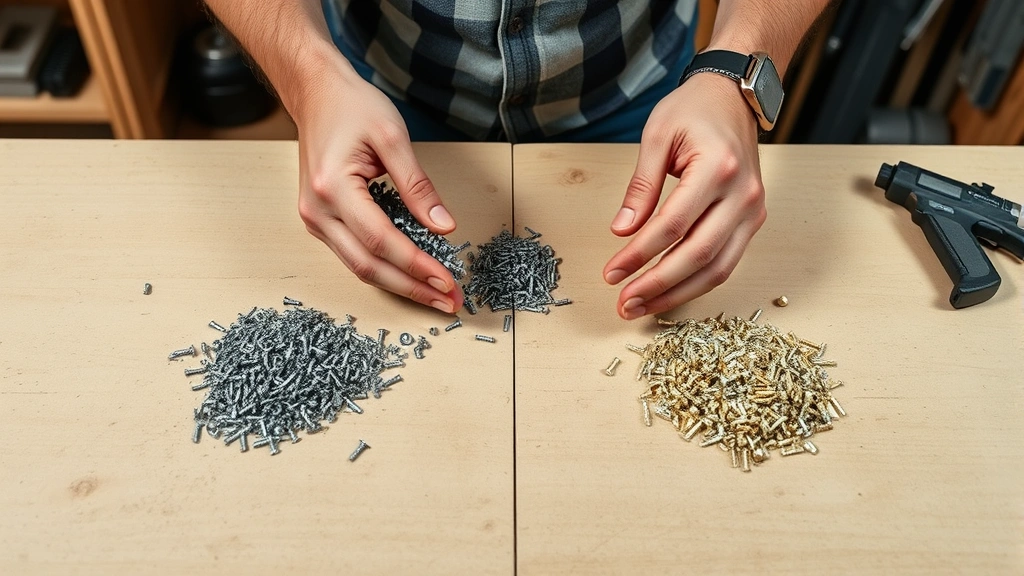
At its core, division answers the question: “How many times does one number fit into another?” If you have 12 cookies and want to distribute them equally among 3 friends, you’re asking how many cookies each friend receives. The answer is 4, because 3 goes into 12 exactly 4 times.
Think of division as the opposite of multiplication. If you know that 3 × 4 = 12, then you automatically know that 12 ÷ 3 = 4. This inverse relationship is crucial to understanding why division works the way it does. When you master this connection, division becomes far less mysterious.
Begin with simple, single-digit divisions before progressing to more complex problems. For example, start with 6 ÷ 2 = 3, then move to 15 ÷ 3 = 5. These basic facts form the foundation upon which all advanced division skills are built. Spend time memorizing these basic division facts, just as you would multiplication tables, because they’re the building blocks for everything that follows.
Visual aids can significantly enhance your understanding. Drawing circles or groups to represent the division process helps cement the concept. For instance, if dividing 8 by 2, draw 8 dots and circle them into 2 equal groups to see that each group contains 4 dots. This tactile approach is especially helpful for visual learners.
Division Terminology and Symbols
Understanding the vocabulary of division is essential for following instructions and communicating about mathematical problems. The dividend is the number being divided (the larger number). The divisor is the number you’re dividing by (the smaller number). The quotient is the answer to the division problem.
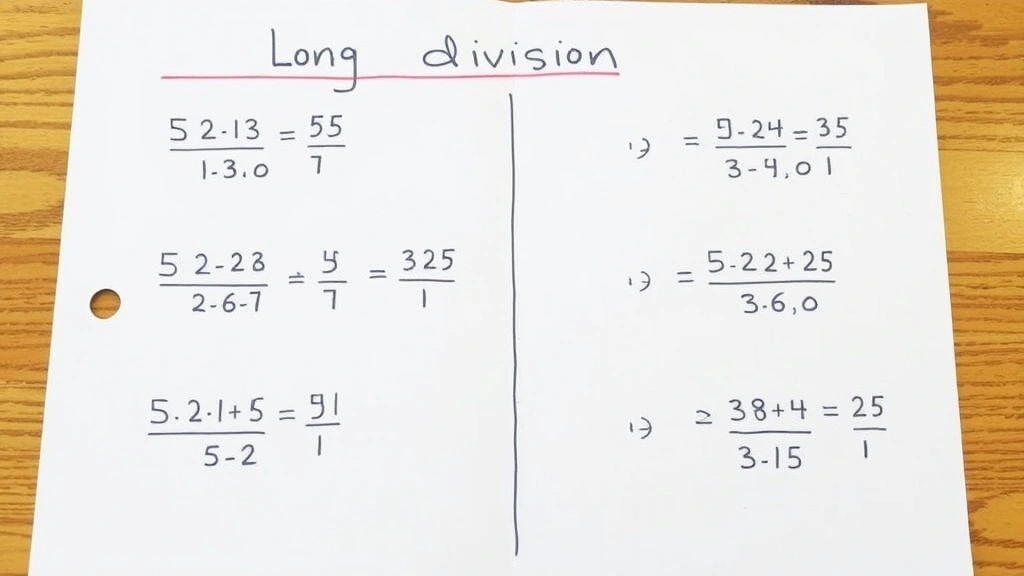
Division can be represented in multiple ways. The most common symbol is the division sign (÷), as in 12 ÷ 3 = 4. However, division is also written as a fraction: 12/3 = 4. In long division format, you’ll see the dividend under a bracket with the divisor outside. All three representations mean exactly the same thing.
The remainder is what’s left over when a number doesn’t divide evenly. For example, 13 ÷ 3 = 4 with a remainder of 1, because 3 goes into 13 four complete times (3 × 4 = 12), with 1 left over. Understanding remainders is crucial for practical applications, such as determining how many trips you need to make or how many containers you need to fill.
When you’re working on home repair projects, you’ll often need to divide materials. Knowing the correct terminology helps you communicate with contractors and understand instructions from guides on the FixWiseHub Blog.
Long Division Step-by-Step
Long division is a systematic method for dividing larger numbers that aren’t immediately obvious. The process might look intimidating at first, but breaking it into steps makes it manageable. Here’s how to perform long division:
- Set up the problem: Write the dividend (number being divided) under a division bracket, with the divisor to the left outside the bracket.
- Divide: Look at the first digit of the dividend. Ask yourself how many times the divisor goes into this digit. If the divisor is larger than this digit, use the first two digits.
- Multiply: Multiply the divisor by the number you determined in step 2. Write this product directly under the digits you were working with.
- Subtract: Subtract the product from the digits above it. Write the remainder below.
- Bring down: Bring down the next digit of the dividend to stand beside your remainder.
- Repeat: Repeat steps 2-5 until you’ve brought down all digits and have a final remainder smaller than your divisor.
Let’s work through an example: 456 ÷ 12. First, 12 doesn’t go into 4, so look at 45. Twelve goes into 45 three times (12 × 3 = 36). Subtract: 45 – 36 = 9. Bring down the 6 to make 96. Twelve goes into 96 exactly 8 times (12 × 8 = 96). Your answer is 38 with no remainder.
Practice this method repeatedly until it becomes automatic. Start with problems where the divisor is a single digit, then progress to two-digit divisors. The more you practice, the faster you’ll become. Many people find that once they understand the logic behind each step, the process becomes intuitive.
Division with Remainders
Not all division problems result in whole numbers. When the dividend doesn’t divide evenly by the divisor, you’re left with a remainder. Understanding how to handle remainders is essential for real-world applications.
There are three common ways to express division with remainders. First, you can write it with the letter R, such as 17 ÷ 5 = 3 R2, meaning 5 goes into 17 three times with 2 left over. Second, you can express it as a mixed number: 3 2/5. Third, you can continue the division process using decimal points to express the remainder as a decimal: 3.4.
For practical purposes, the format you use depends on context. If you’re dividing 17 cookies among 5 people, expressing it as “3 R2” makes sense—each person gets 3 whole cookies with 2 remaining. If you’re measuring distances or dealing with money, decimal notation (3.4) is more appropriate. When working on home improvement projects, remainders often tell you important information, such as how many extra fasteners you’ll have or whether you need an additional material.
Always verify your division by multiplying the quotient by the divisor and adding the remainder. The result should equal your original dividend. For 17 ÷ 5 = 3 R2: (5 × 3) + 2 = 15 + 2 = 17. This check ensures your answer is correct and builds confidence in your work.
Mental Math Division Tricks
Developing mental math skills for division makes you faster and more confident. Several tricks can help you divide numbers quickly without writing anything down.
Dividing by 10, 100, or 1000: This is the easiest trick. Simply move the decimal point to the left by the same number of zeros. For example, 250 ÷ 10 = 25, and 3500 ÷ 100 = 35. This pattern works because our number system is based on tens.
Dividing by 5: Multiply the number by 2, then divide by 10. For example, 85 ÷ 5: (85 × 2) ÷ 10 = 170 ÷ 10 = 17. This works because 5 is half of 10, so doubling and then dividing by 10 gives the same result.
Recognizing patterns: Learn which numbers divide evenly into others. Numbers ending in 0 or 5 are always divisible by 5. Even numbers are always divisible by 2. If the digits of a number sum to a multiple of 3, the number is divisible by 3. These patterns help you quickly identify when division will result in whole numbers.
Breaking numbers apart: Divide numbers into parts that are easier to work with. For example, 96 ÷ 8 can be thought of as (80 + 16) ÷ 8 = 10 + 2 = 12. This technique makes complex divisions more manageable.
Common Division Mistakes
Even experienced mathematicians occasionally make division errors. Being aware of common pitfalls helps you avoid them.
Misplacing the decimal point: When working with decimals, it’s easy to move the decimal point the wrong direction. Remember: dividing by 10 moves the decimal point left, making the number smaller. Dividing by 0.1 moves it right, making the number larger.
Forgetting remainders: Some people focus so intently on getting a quotient that they forget about remainders. Always account for what’s left over, as this information is often crucial for practical applications.
Writing digits in wrong positions: In long division, placing quotient digits in incorrect columns leads to wrong answers. Always align your digits carefully and double-check your work.
Division by zero: This is mathematically impossible. You cannot divide any number by zero. If you encounter this in a problem, it indicates an error in the problem itself.
Confusing dividend and divisor: Switching these numbers completely changes your answer. 12 ÷ 3 = 4, but 3 ÷ 12 = 0.25. Always carefully identify which number is being divided and which is doing the dividing.
Practical Applications at Home
Division skills are invaluable for countless household tasks. When planning DIY projects or managing your home, you’ll regularly use division.
Budget management: If you want to divide your monthly household expenses equally among family members or allocate your home improvement budget across multiple projects, division is essential. Understanding how to split costs helps you make informed financial decisions.
Cooking and recipe scaling: Dividing recipe ingredients when feeding fewer people or expanding recipes for larger gatherings requires division. If a recipe serves 8 but you’re cooking for 4, you divide all ingredients by 2.
Material calculations: Home improvement projects frequently require dividing materials. If you have 48 feet of trim and want to divide it equally among 6 windows, you need 8 feet per window. Understanding how to manage materials efficiently saves money and reduces waste.
Space planning: Dividing room dimensions to plan furniture placement or determining how much flooring you need involves division. Accurate calculations ensure your space looks balanced and functions well.
Time management: If you have 4 hours to complete multiple tasks, dividing that time equally among them helps you stay organized. For example, 4 hours ÷ 3 tasks ≈ 1 hour 20 minutes per task.
Sharing and distribution: Whether you’re dividing supplies among family members or distributing tasks across a team working on home repairs, division ensures fairness and organization. Visit authoritative resources like Family Handyman for more practical home improvement guidance that often requires mathematical calculations.
FAQ
What’s the easiest way to learn division?
Start with basic single-digit divisions and multiplication facts. Use visual aids like drawing groups or using objects. Practice regularly, even just 10-15 minutes daily. Understand the connection between multiplication and division, as this makes the concept click much faster. Once you’re comfortable with basics, progress to long division using the step-by-step method outlined in this guide.
Why is understanding remainders important?
Remainders tell you crucial information in real-world scenarios. If you’re dividing materials, a remainder means you need an additional piece or have extras. In scheduling, a remainder might mean you need extra time or an additional round. Ignoring remainders leads to incomplete or incorrect solutions to practical problems.
How can I check my division answers?
Multiply your quotient by the divisor. If there’s a remainder, add it to this product. The result should equal your original dividend. For example, if 17 ÷ 5 = 3 R2, check it: (5 × 3) + 2 = 17. This verification method works for all division problems and builds confidence in your answers.
What’s the difference between long division and short division?
Long division is a written method that works for all problems and shows all steps clearly. Short division is a mental shortcut used for simpler problems with single-digit divisors. Short division is faster once mastered but requires stronger mental math skills. Start with long division to build a solid foundation.
How does division relate to fractions?
Division and fractions are closely related. The fraction 3/4 means 3 divided by 4, which equals 0.75. Every division problem can be expressed as a fraction, and every fraction can be expressed as a division problem. Understanding this connection helps you work with both concepts more effectively. For more foundational math skills, explore the complete FixWiseHub Blog for practical applications.
Can division be done with negative numbers?
Yes, division works with negative numbers following specific rules. A negative number divided by a positive number gives a negative result. Two negative numbers divided together give a positive result. These rules follow the same logic as multiplication with negative numbers.
Why should I practice mental division?
Mental division makes you faster at solving problems and more confident in your mathematical abilities. It’s useful in situations where you can’t write anything down, such as while shopping or cooking. Mental math also strengthens your understanding of how numbers relate to each other, which improves overall mathematical thinking.

Related Posts

Remove Deodorant Stains? Expert Tips Inside

Remove Security Tags at Home? Expert Tips Inside