
Master Multiplying Fractions: Boost Your Math Skills Today
Multiplying fractions is a fundamental mathematical skill that forms the foundation for more advanced mathematical concepts. Whether you’re a student struggling with homework, a parent helping your child, or an adult looking to refresh your math skills, understanding how to multiply fractions is essential for success in mathematics and everyday problem-solving situations.
This comprehensive guide will take you through everything you need to know about multiplying fractions, from basic concepts to advanced techniques. We’ll explore step-by-step methods, common mistakes to avoid, and practical applications that demonstrate why this skill is so valuable in real-world scenarios.
Understanding Fractions and Their Components
Before diving into multiplication, it’s crucial to understand what fractions represent. A fraction consists of two main parts: the numerator (top number) and the denominator (bottom number). The numerator represents how many parts we have, while the denominator indicates how many equal parts make up the whole.
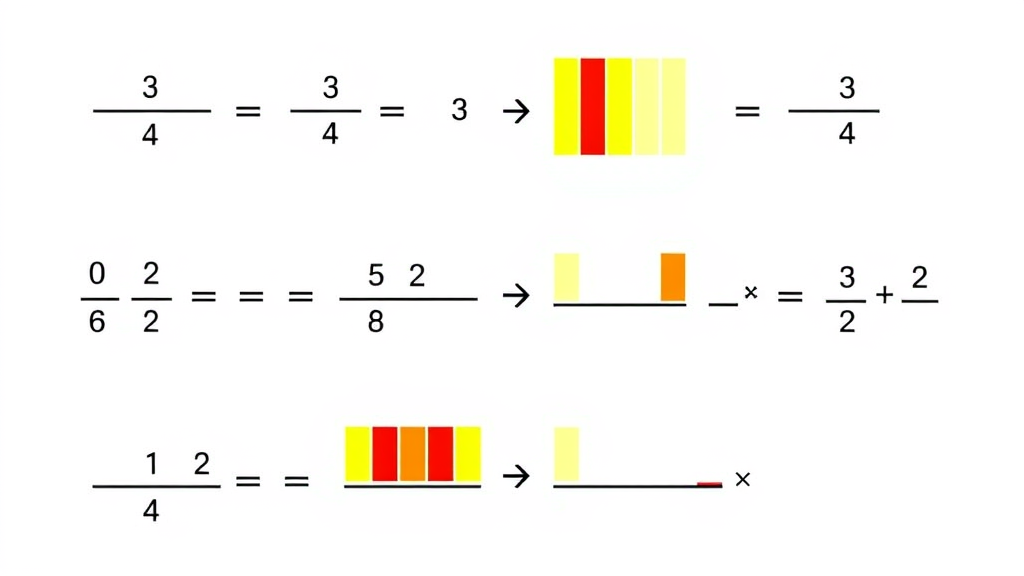
For example, in the fraction 3/4, we have 3 parts out of 4 equal parts that make up the whole. This visual understanding is fundamental when learning how to multiply fractions effectively. Think of fractions as pieces of a pie or segments of a chocolate bar – this concrete imagery helps make abstract mathematical concepts more accessible.
Understanding equivalent fractions is also essential for multiplication success. Fractions like 1/2, 2/4, and 3/6 all represent the same value, just expressed differently. This knowledge becomes particularly useful when simplifying results after multiplication, much like how precision matters when you need to measure ring size accurately.
The Basic Rule for Multiplying Fractions
The fundamental rule for multiplying fractions is surprisingly simple: multiply the numerators together and multiply the denominators together. This straightforward approach, expressed as (a/b) × (c/d) = (a×c)/(b×d), forms the foundation of all fraction multiplication problems.
Unlike addition and subtraction of fractions, multiplication doesn’t require finding common denominators. This makes it one of the more accessible fraction operations for students to master. The key is understanding that when you multiply fractions, you’re finding a part of a part, which naturally results in a smaller value than either original fraction.
For instance, when calculating 1/2 × 1/3, you’re finding one-third of one-half, which equals 1/6. This conceptual understanding helps students grasp why the multiplication rule works and builds confidence in applying it to more complex problems.
Step-by-Step Process for Multiplying Fractions
Let’s break down the multiplication process into clear, manageable steps. First, identify the numerators and denominators in both fractions. Write them clearly to avoid confusion during calculation. Second, multiply the numerators together to get your new numerator. Third, multiply the denominators together to get your new denominator.
For example, with 2/5 × 3/7: Step 1 identifies numerators (2 and 3) and denominators (5 and 7). Step 2 calculates 2 × 3 = 6 for the new numerator. Step 3 calculates 5 × 7 = 35 for the new denominator, giving us 6/35 as our result.
The fourth step involves checking if your result can be simplified by finding the greatest common divisor (GCD) of the numerator and denominator. This final step ensures your answer is in its simplest form, making it easier to understand and use in further calculations.
Simplifying Your Results
Simplifying fractions after multiplication is a crucial skill that makes your answers more meaningful and easier to work with. To simplify a fraction, you need to find the greatest common divisor (GCD) of both the numerator and denominator, then divide both numbers by this value.
Consider the result 12/18 from multiplying two fractions. The factors of 12 are 1, 2, 3, 4, 6, and 12, while the factors of 18 are 1, 2, 3, 6, 9, and 18. The greatest common divisor is 6, so we divide both numbers by 6: 12÷6 = 2 and 18÷6 = 3, giving us the simplified fraction 2/3.
Some students find it helpful to simplify before multiplying by canceling common factors across numerators and denominators. This technique, called cross-cancellation, can make calculations easier and reduce the need for simplification at the end. For example, in 4/9 × 3/8, you can cancel the 4 and 8 (dividing both by 4) to get 1/9 × 3/2 = 3/18 = 1/6.

Multiplying Mixed Numbers
Mixed numbers, which combine whole numbers with fractions (like 2 1/3), require an additional step before multiplication can occur. You must first convert mixed numbers to improper fractions, where the numerator is larger than the denominator.
To convert a mixed number to an improper fraction, multiply the whole number by the denominator, add the numerator, and place this sum over the original denominator. For example, 2 1/3 becomes (2×3+1)/3 = 7/3. Once both mixed numbers are converted to improper fractions, you can multiply them using the standard rule.
After multiplying improper fractions, you may want to convert your result back to a mixed number if it’s greater than one. Divide the numerator by the denominator; the quotient becomes the whole number, and the remainder becomes the new numerator over the original denominator. This process ensures your final answer is in the most appropriate form for the context.
Real-World Applications of Fraction Multiplication
Understanding how to multiply fractions opens doors to solving countless real-world problems. In cooking, you might need to multiply recipe ingredients by 2/3 to reduce serving sizes. In construction, calculating areas often involves multiplying fractional measurements. In finance, determining partial payments or proportional investments requires fraction multiplication skills.
Consider a practical scenario where you’re painting a room that’s 3/4 finished, and you need to apply a second coat to 2/3 of what’s already painted. You’d calculate 3/4 × 2/3 = 6/12 = 1/2, meaning you need to paint half the total room area. Just as attention to detail matters when you check engine oil levels, precision in fraction calculations ensures accurate results in practical applications.
Professional fields like engineering, medicine, and architecture regularly use fraction multiplication for measurements, dosage calculations, and scaling drawings. These applications demonstrate why mastering this skill extends far beyond academic requirements – it’s a practical tool for success in many careers and daily life situations.
Common Mistakes and How to Avoid Them
One of the most frequent mistakes students make is adding denominators instead of multiplying them. This error often stems from confusion with fraction addition rules. Remember that multiplication follows the simple rule: multiply across, both numerators and denominators.
Another common error involves forgetting to simplify the final answer. While 6/12 is mathematically correct, the simplified form 1/2 is more meaningful and easier to understand. Always check if your result can be reduced to its simplest form.
Students also sometimes struggle with mixed numbers, either forgetting to convert them to improper fractions first or making errors in the conversion process. Taking time to double-check conversions prevents cascading errors throughout the problem. Additionally, some students panic when they see larger numbers, but the process remains the same regardless of the numbers’ size – just like staying calm and methodical when you need to recall an email in Outlook under pressure.
Practice Strategies and Tips
Effective practice involves starting with simple problems and gradually increasing complexity. Begin with basic proper fractions before moving to mixed numbers and more challenging combinations. Use visual aids like fraction circles or bars to reinforce conceptual understanding alongside procedural skills.
Create practice problems from real-life situations to make learning more engaging and meaningful. Calculate cooking measurements, construction materials, or budget allocations using fraction multiplication. This approach helps students see the practical value of their mathematical skills while building confidence.
Regular practice sessions, even just 10-15 minutes daily, prove more effective than lengthy cramming sessions. Keep a practice journal to track progress and identify areas needing additional attention. For additional resources and practice materials, visit our blog for more mathematical learning strategies.
Consider using online tools and educational apps that provide immediate feedback on fraction multiplication problems. These digital resources often include step-by-step solutions and hints, making them valuable supplements to traditional practice methods. The Khan Academy offers excellent free resources for practicing fraction operations with interactive exercises and video explanations.
Frequently Asked Questions
What’s the easiest way to remember the rule for multiplying fractions?
The simplest way to remember fraction multiplication is the phrase “multiply straight across.” Unlike addition or subtraction, you don’t need common denominators – just multiply numerator by numerator and denominator by denominator. Many students find it helpful to think of it as (top × top) over (bottom × bottom).
Why do I get a smaller number when multiplying fractions?
When multiplying proper fractions (where numerators are smaller than denominators), you’re finding a part of a part, which naturally results in a smaller value. For example, 1/2 × 1/3 means “one-third of one-half,” which is smaller than either original fraction. This only applies when both fractions are less than 1.
Do I always need to simplify my answer after multiplying fractions?
While not mathematically required, simplifying fractions makes them easier to understand and use in further calculations. Most teachers and textbooks expect simplified answers. For example, 6/12 should be simplified to 1/2. Always check if your numerator and denominator share common factors that can be divided out.
How do I multiply a whole number by a fraction?
To multiply a whole number by a fraction, convert the whole number to a fraction by placing it over 1. For example, to calculate 4 × 2/3, rewrite it as 4/1 × 2/3 = 8/3. You can also multiply the whole number by just the numerator: 4 × 2/3 = (4×2)/3 = 8/3.
What’s the difference between multiplying and dividing fractions?
Multiplication involves multiplying numerators together and denominators together. Division requires you to multiply by the reciprocal (flip the second fraction). So while 1/2 × 1/3 = 1/6, the problem 1/2 ÷ 1/3 becomes 1/2 × 3/1 = 3/2. According to Math is Fun, understanding this difference is crucial for fraction operations.
Can I use cross-cancellation when multiplying fractions?
Yes, cross-cancellation can simplify calculations by reducing numbers before multiplication. If a numerator and denominator share common factors, you can divide both by that factor. For example, in 4/9 × 3/8, you can cancel the 4 and 8 (both divisible by 4) to get 1/9 × 3/2, making the multiplication easier.
How do I check if my fraction multiplication answer is correct?
Several methods can verify your answer: convert fractions to decimals and multiply those, use cross-multiplication to check equivalence, or work backwards by dividing your result by one of the original fractions. Additionally, estimate your answer before calculating – if you’re multiplying two fractions less than 1, your result should be smaller than both original fractions. The Purple Math website provides excellent verification strategies for fraction operations.

Related Posts

How Long to Boil Lobster Tails: Cooking Guide

How Long to Fly from New York to London? Travel Times
